Manuscript Figures
NTX now includes a manuscript-ready figure bundle built directly from repository examples.
Curated Figure Set
Main Text
validation_summary.{png,pdf,json}closure_validation_report.{png,pdf,json,txt}bootstrap_current_reference_audit_w7x.{png,pdf}derivative_path_benchmark.{png,pdf,json}bootstrap_current_optimization.{png,pdf,json}performance_scaling_production.{png,pdf,json}primitive_profile_transport.{png,pdf}
Supplement
autodiff_inverse_problem.{png,pdf}autodiff_neopax_profiles.{png,pdf}autodiff_profile_uncertainty.{png,pdf,json}geometry_control_derivative_benchmark.{png,pdf,json}file_backed_geometry_control_derivative_benchmark.{png,pdf,json}boundary_forward_mode_current_derivative_benchmark.{png,pdf,json}implicit_equilibrium_forward_mode_derivative_benchmark.{png,pdf,json}explicit_relaxed_boundary_current_derivative_benchmark.{png,pdf,json}geometry_family_breadth_summary.{png,pdf,json}geometry_family_transport_convergence.{png,pdf,json}boozmn_finite_beta_wout_roundtrip_audit.{png,pdf,json}owned_geometry_neopax_dataset.{png,pdf,json}owned_finite_beta_sfincs_jax_inputs.{png,pdf,json}owned_finite_beta_sfincs_jax_resolution_audit.{png,pdf,json}owned_finite_beta_sfincs_jax_production_ladder_audit.{png,pdf,json}owned_finite_beta_sfincs_jax_profile_current_audit.{png,pdf,json}owned_finite_beta_bootstrap_comparison.{png,pdf,json}owned_finite_beta_closure_localization.{png,pdf,json}owned_finite_beta_profile_current_observable_audit.{png,pdf,json}owned_finite_beta_current_conditioning_audit.{png,pdf,json}owned_finite_beta_closure_quadrature_audit.{png,pdf,json}owned_finite_beta_source_channel_audit.{png,pdf,json}owned_finite_beta_source_response_profile_audit.{png,pdf,json}owned_finite_beta_closure_target_audit.{png,pdf,json}owned_finite_beta_radial_interpolation_audit.{png,pdf,json}owned_finite_beta_field_radius_matched_closure_quadrature_audit.{png,pdf,json}owned_finite_beta_field_radius_matched_source_channel_audit.{png,pdf,json}bootstrap_current_from_vmec_or_boozmn.{png,pdf,json}bootstrap_current_robust_optimization.{png,pdf,json}performance_scaling_smoke.{png,pdf,json}performance_scaling_heavy.{png,pdf,json}performance_strong_scaling_production.{png,pdf,json}prepared_geometry_reuse_profile.{png,pdf,json}ambipolar_profile.{png,pdf}ambipolar_profile_family.{png,pdf}profile_force_reconstruction_audit.{png,pdf,json}profile_control_optimization.{png,pdf}profile_basis_optimization.{png,pdf,json}profile_transport_loop.{png,pdf}angular_oversampling_audit.{png,pdf,json}
Full Figure Inventory
validation_summary.{png,pdf,json}transport-curve behavior on the sample DKES-style and VMEC surfaces
Onsager closure
Legendre convergence
machine-readable benchmark metrics for the literature-anchored methods lane
closure_validation_report.{png,pdf,json,txt}fixed-field precise-QS Redl gate and scoped NTX+NEOPAX total-current closure stress gate in the same manuscript-facing validation report
autodiff_inverse_problem.{png,pdf}inverse recovery of a surface harmonic from synthetic transport data
autodiff_neopax_profiles.{png,pdf}autodiff-based profile inversion on NEOPAX-style arrays
autodiff_profile_uncertainty.{png,pdf,json}three-term radial-basis uncertainty propagation on the same differentiable profile fit, including Monte Carlo, linearized covariance, and Fisher/Hessian-vector consistency diagnostics
geometry_control_derivative_benchmark.{png,pdf,json}three-harmonic geometry-control derivative audit against centered finite differences; tracked as an autodiff stress benchmark
file_backed_geometry_control_derivative_benchmark.{png,pdf,json}file-backed Boozer and VMEC geometry-control derivative audit against centered finite differences; stronger than the owned-surface stress test but still below a reusable geometry-family claim
boundary_forward_mode_current_derivative_benchmark.{png,pdf,json}low-dimensional boundary controls propagated through boundary-projected
vmex -> booz_xform_jax -> NTXand anNTX+NEOPAXintegrated-current objective under forward mode
implicit_equilibrium_forward_mode_derivative_benchmark.{png,pdf,json}low-dimensional boundary controls propagated through the implicit fixed-boundary
vmexresidual solve,booz_xform_jax, and an NTX monoenergetic transport response under forward mode, with the reverse-mode Boozer failure recorded in the JSON artifact
explicit_relaxed_boundary_current_derivative_benchmark.{png,pdf,json}
low-dimensional boundary controls propagated through an explicitly relaxed fixed-boundary
vmex -> booz_xform_jax -> NTXpath and anNTX+NEOPAXintegrated-current objective, with ordinary-versus-explicit primal-volume agreement recorded on committed QA and QH family cases
geometry_family_breadth_summary.{png,pdf,json}
artifact-backed breadth summary across analytic, file-backed, boundary-projected, explicit-relaxed, and implicit-equilibrium derivative paths; this is a stress summary and not a broad geometry-family validation claim
geometry_family_transport_convergence.{png,pdf,json}
public VMEC example-family
D11/D31/D33convergence stress scan across tokamak, precise-QS, QI-style, W7-X, and stellarator-family inputs when the local checkouts are available; this is not an independent-code parity claim
boozmn_finite_beta_wout_roundtrip_audit.{png,pdf,json}
optimized finite-beta finalized-wout magnetic-channel Boozer transfer audit; validates same-coordinate file-backed
D11/D31/D13/D33round-trip behavior while leaving fully differentiable finite-beta state sensitivities as a non-shipping lane for unsupported current-profile representations
owned_geometry_neopax_dataset.{png,pdf,json}
finite-beta owned
input/wout -> NTX -> NEOPAX-styleprovenance figure, with the physical VMEC edge-flux scale passed into the Boozer-coordinate path, direct VMEC-harmonic interpolation-path stress diagnostics, and explicit geometry-backend blockers in the JSON sidecar
owned_finite_beta_sfincs_jax_inputs.{png,pdf,json}
six-point same-grid SFINCS-JAX finite-beta coefficient ladder with completed HDF5 ingestion, the SFINCS-reported
nuPrime -> nu_nbridge, and a coefficient-level NTXL13/L31/L33comparison before profile-current parity promotion
owned_finite_beta_sfincs_jax_resolution_audit.{png,pdf,json}
production stress-radius rerun of the same finite-beta coefficient point at
35 x 43 x 48, plus a tighter VMEC harmonic-cutoff probe; the coefficient floor remains near2.05e-2, about15.8xabove the cancellation-conditioned current target
owned_finite_beta_sfincs_jax_production_ladder_audit.{png,pdf,json}
production six-point finite-beta QA same-grid SFINCS-JAX/NTX ladder across radius and collisionality; all coefficient differences stay below
2.07e-2, with the current-conditioned precision gap localized to the most cancellation-sensitive radius
owned_finite_beta_sfincs_jax_profile_current_audit.{png,pdf,json}
bounded RHSMode=1 profile-current diagnostic on the same finite-beta VMEC/profile contract; retained as a convergence and normalization diagnostic, not as a parity claim, because the direct profile-current amplitudes need their own pitch/velocity/radial ladder
owned_finite_beta_sfincs_jax_profile_current_resolution_audit.{png,pdf,json}
same-contract RHSMode=1 pitch Legendre truncation audit; the sparse-PC solver residual lane is closed, and the high-
Nxieven/odd terminal-mode gap of about1.32e-1is accepted under the1.5e-1reduced-closure stress tolerance
owned_finite_beta_bootstrap_comparison.{png,pdf,json}
same finite-beta QA pressure/current
wout, Boozer transform, analytic profiles, normalized-radiusB00(rho)Boozer-field convention, production radial/collisionality ladder, physicalnu/vsupport,D33_spitzerbranch, and current normalization used for Redl andNTX+NEOPAX; retained as a reduced-closure stress audit because the corrected-field current residual remains above the1e-1target over the profile
owned_finite_beta_closure_localization.{png,pdf,json}
sidecar figure and JSON that compare the same-grid coefficient ladder with the finite-beta profile-current stress artifact; the coefficient ladder stays below the coefficient gate while the current-profile residual remains above the
1e-1current gate
owned_finite_beta_profile_current_observable_audit.{png,pdf,json}
stress-radius decomposition of the profile-current observable into no-momentum current, applied momentum correction, correction needed to match Redl, species-current cancellation scale, local profile/geometry drivers, and Pmax trend
owned_finite_beta_current_conditioning_audit.{png,pdf,json}
cancellation-conditioned coefficient-precision requirement for the finite-beta net-current observable; this explains why the smoke coefficient ladder is not yet sufficient for a
1e-1bootstrap-current parity claim
owned_finite_beta_closure_quadrature_audit.{png,pdf,json}
Sonine-order versus velocity-quadrature stress audit; the accepted quadrature-stable pass count is zero and the best stress value remains above
1e-1, so no apparent finite-beta current-gate pass is promoted
owned_finite_beta_source_channel_audit.{png,pdf,json}
frozen stress-radius source-channel decomposition of the same momentum-restoring system; one-channel solves reconstruct the full current to roundoff and localize the high-order response to mixed density/electric and temperature-gradient drives under the current profile contract; Redl density and temperature target terms are stored on the same observable rather than converted into a fitted runtime correction
owned_finite_beta_source_response_profile_audit.{png,pdf,json}
profile-wide source-response map at
X=18, P=18; the temperature-channel response multiplier spans0.765to1.349with median1.040, preserves source sign agreement, and keeps the maximum current stress at the inner radius while storing correlations with Redl collisionality and geometry factors
owned_finite_beta_closure_target_audit.{png,pdf,json}
driver-identification artifact for the profile source-response target; the strongest single local driver is the Redl geometry factor
epsilon(|r|=0.970), the best leave-one-out diagnostic model is epsilon-only with RMSE5.58e-2; the JSON also cross-links the field-radius-matched source/quadrature sidecars, confirming the same stress radius, exact source reconstruction, and no quadrature-stable current-gate pass, with no runtime correction applied
owned_finite_beta_radial_interpolation_audit.{png,pdf,json}
interpolation-contract diagnostic; rebuilding the finite-beta database on the exact field radii changes individual radii but leaves the full-profile maximum near
2.3e-1, so no runtime interpolation policy is promoted
owned_finite_beta_field_radius_matched_closure_quadrature_audit.{png,pdf,json}
field-radius-matched Sonine/quadrature rerun; the best apparent stress value remains above
1e-1, the quadrature-stable pass count is zero, andX=18, P=18gives about1.44e-1, so the remaining current gap is not closed by interpolation removal or Pmax alone
owned_finite_beta_field_radius_matched_source_channel_audit.{png,pdf,json}
field-radius-matched source-channel rerun; one-channel solves reconstruct the corrected current to roundoff, and the quadrature-stable
X=18,P=18response remains a reduced-closure stress diagnostic
derivative_path_benchmark.{png,pdf}
prepared-derivative timing and agreement against direct reverse-mode
bootstrap_current_optimization.{png,pdf}
science/application figure for differentiable bootstrap-current optimization
bootstrap_current_robust_optimization.{png,pdf,json}
deterministic versus robust optimization under a prescribed control uncertainty; tracked as an open robust-design lane
bootstrap_current_from_vmec_or_boozmn.{png,pdf}
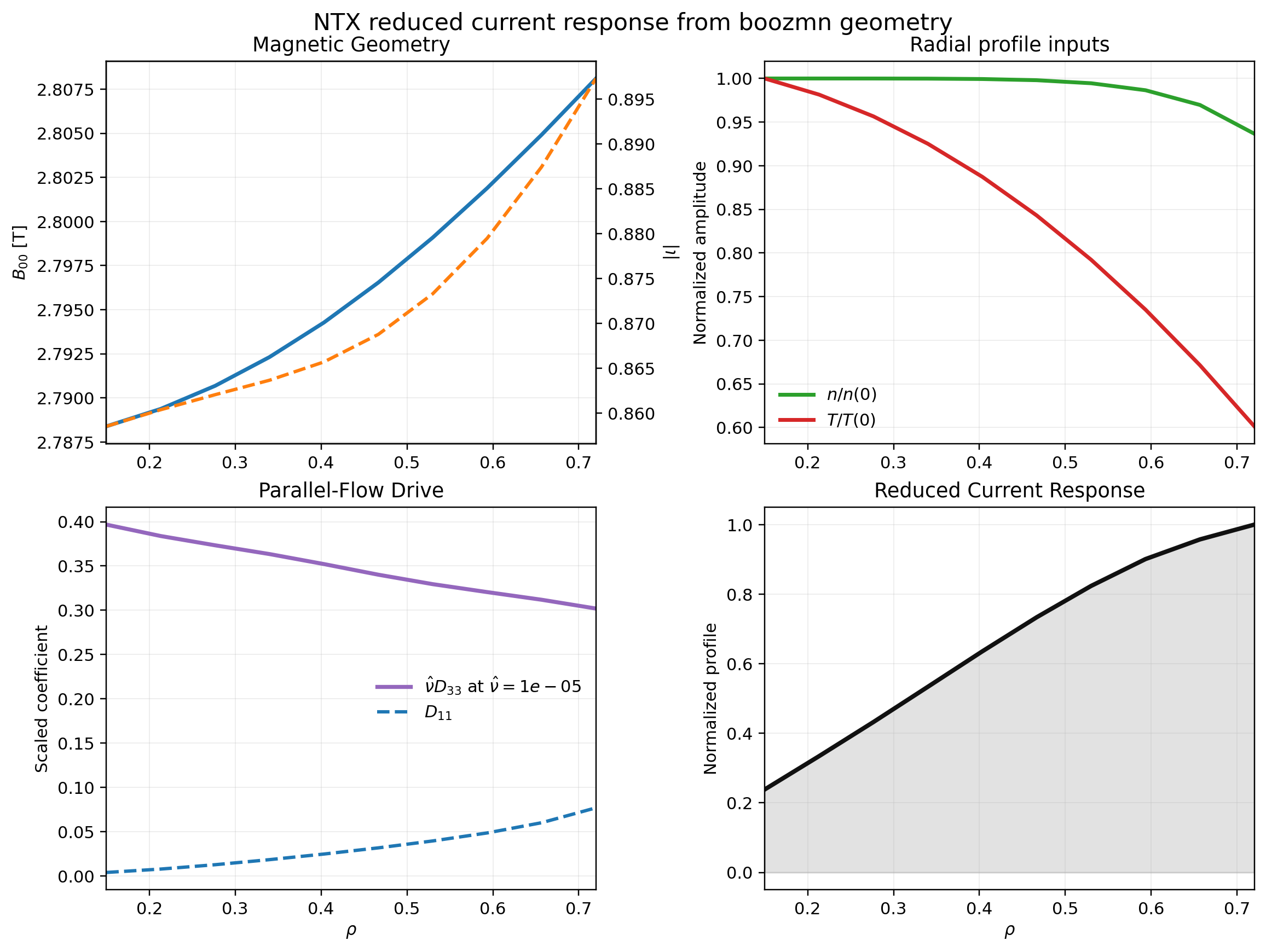
NTX-only reduced bootstrap-current response profile from VMEC/Boozer input
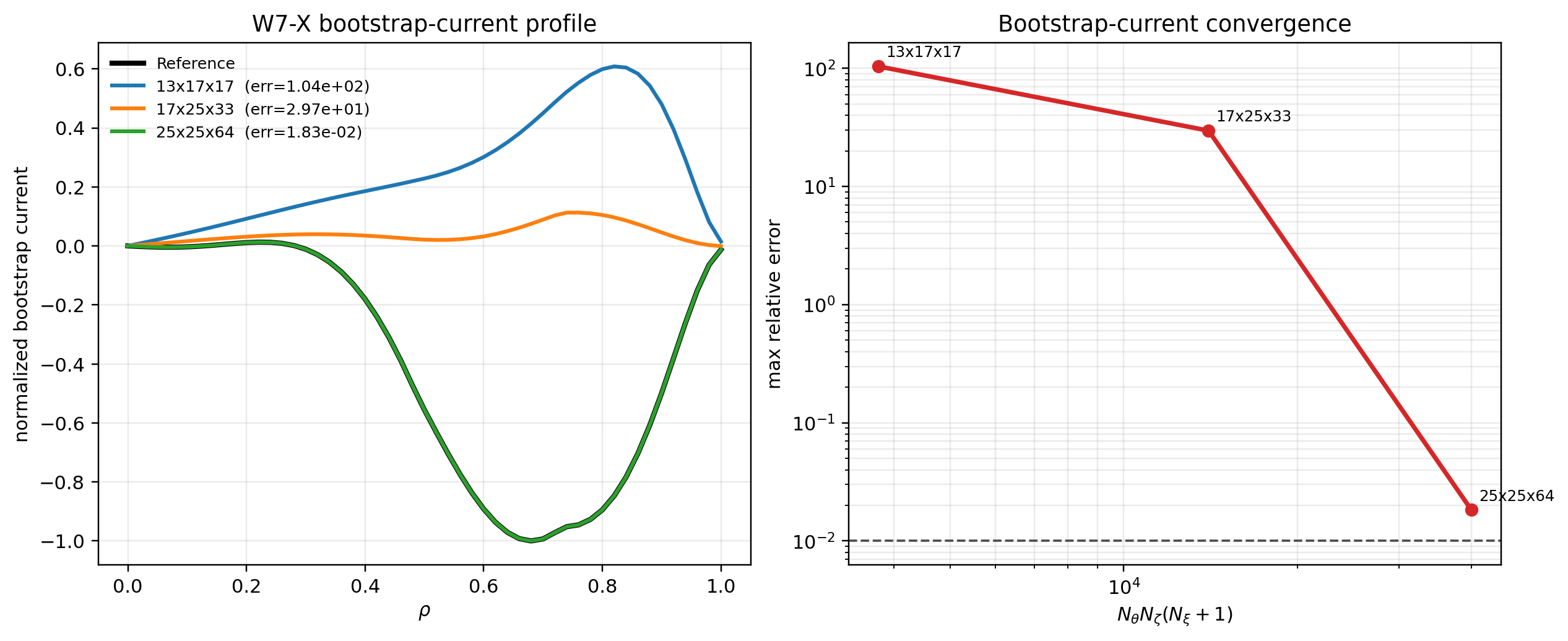
bootstrap_current_reference_audit_w7x.{png,pdf}
W7-X imported-workflow bootstrap-current convergence audit
performance_scaling_smoke.{png,pdf,json}
CPU/GPU scaling on the repository smoke grid
performance_scaling_heavy.{png,pdf,json}
heavier-grid scaling where throughput effects are visible
performance_scaling_production.{png,pdf,json}
production-grid CPU/GPU scaling with serial, device-parallel, multiprocess, memory, and coefficient-agreement metadata
performance_strong_scaling_production.{png,pdf,json}
fixed-workload CPU/GPU strong scaling with worker/device sweeps, memory, and coefficient-agreement metadata
prepared_geometry_reuse_profile.{png,pdf,json}
fixed-geometry repeated-solve profile showing the direct, prepared, and compiled prepared solver paths with coefficient agreement recorded in the JSON artifact
ambipolar_profile.{png,pdf}
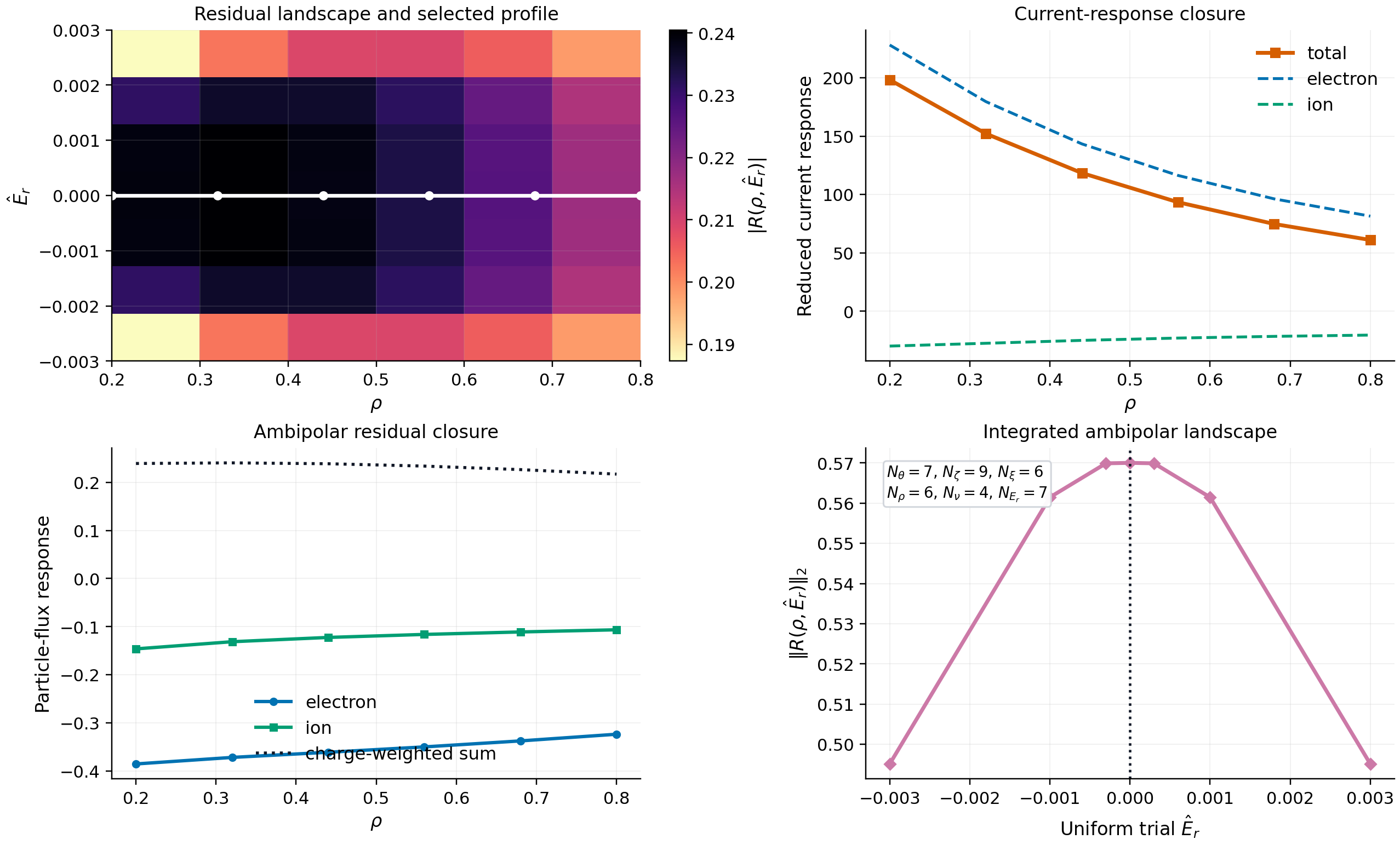
profile-grade ambipolar electric-field solve and reduced bootstrap-current response
ambipolar_profile_family.{png,pdf}
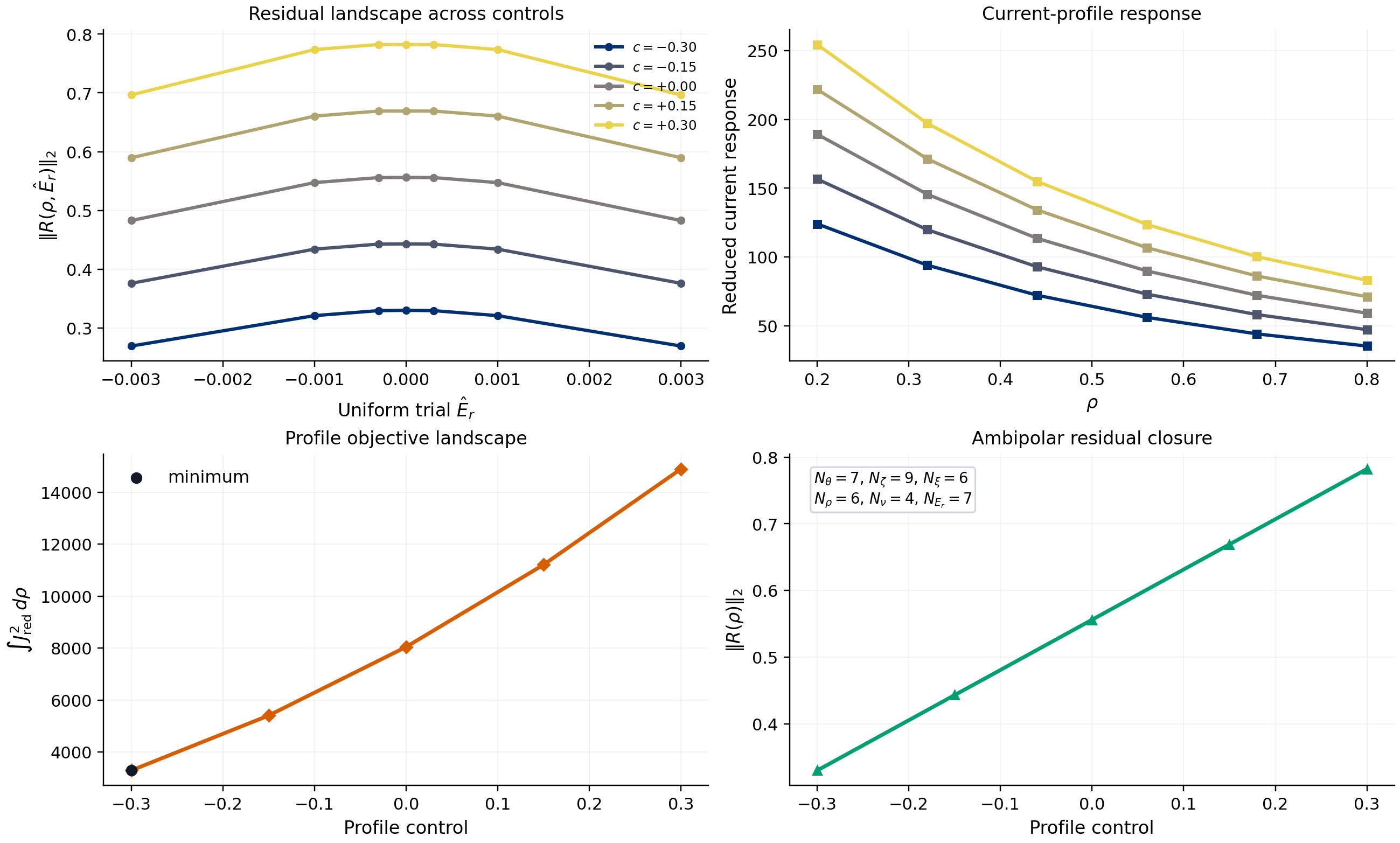
control-parameter family of ambipolar closures and scalar bootstrap-current objective
profile_force_reconstruction_audit.{png,pdf,json}
archived precise-QS QA/QH primitive-to-force reconstruction audit
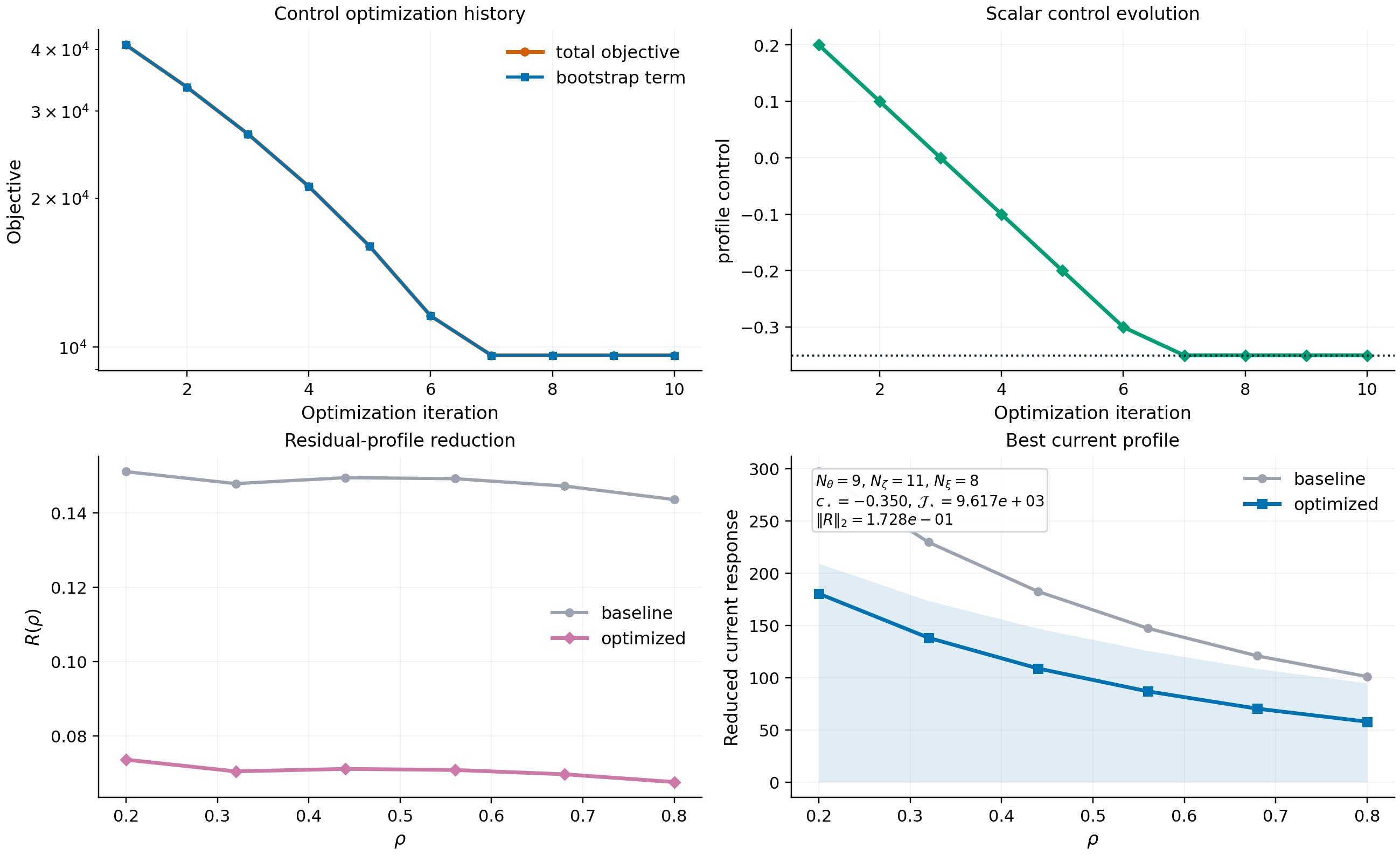
profile_control_optimization.{png,pdf}
differentiable optimization of a scalar profile control on top of the ambipolar closure
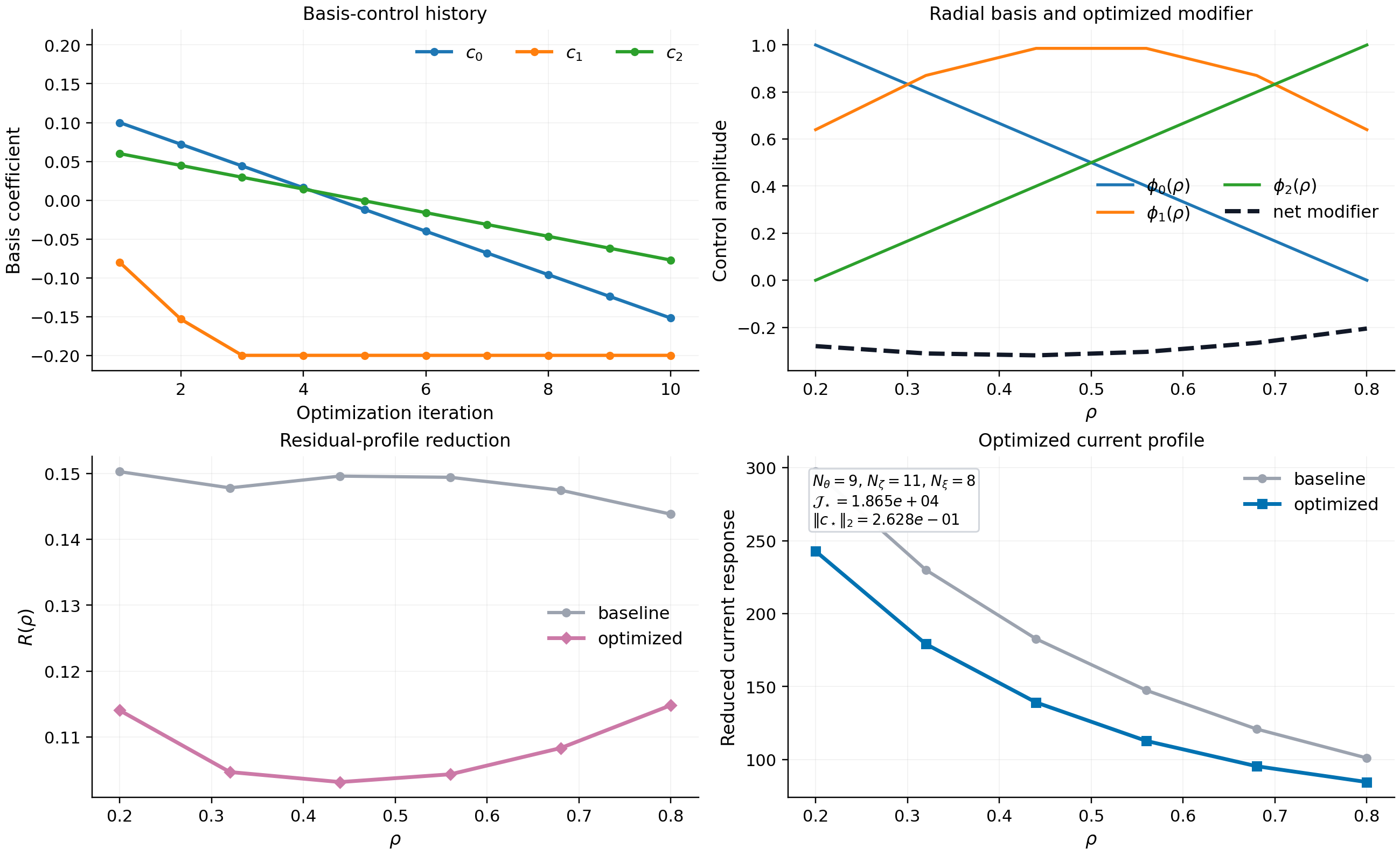
profile_basis_optimization.{png,pdf,json}
low-dimensional radial-basis optimization of the same profile closure
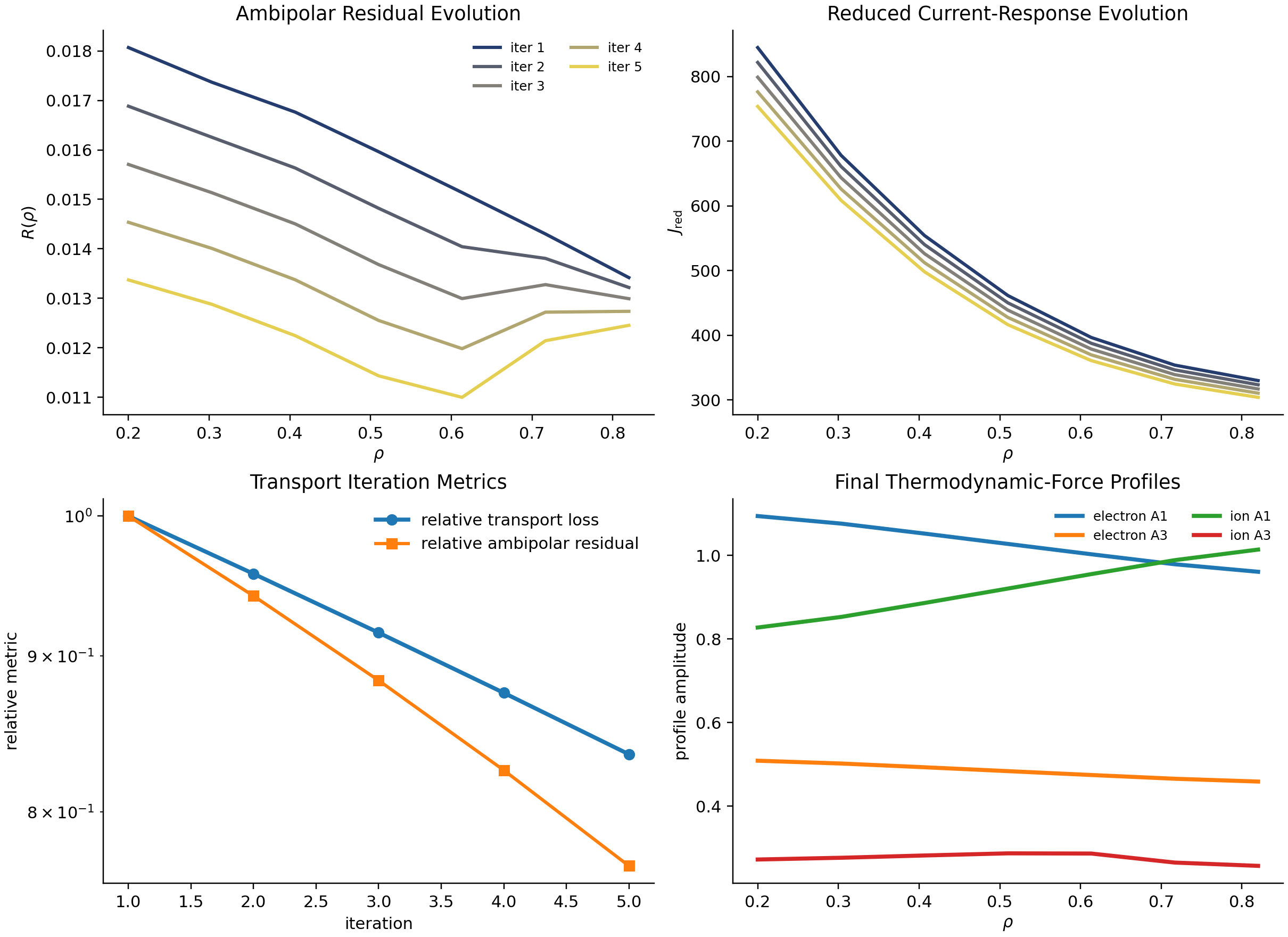
profile_transport_loop.{png,pdf}
explicit self-consistent transport-relaxation iteration on the same profile closure
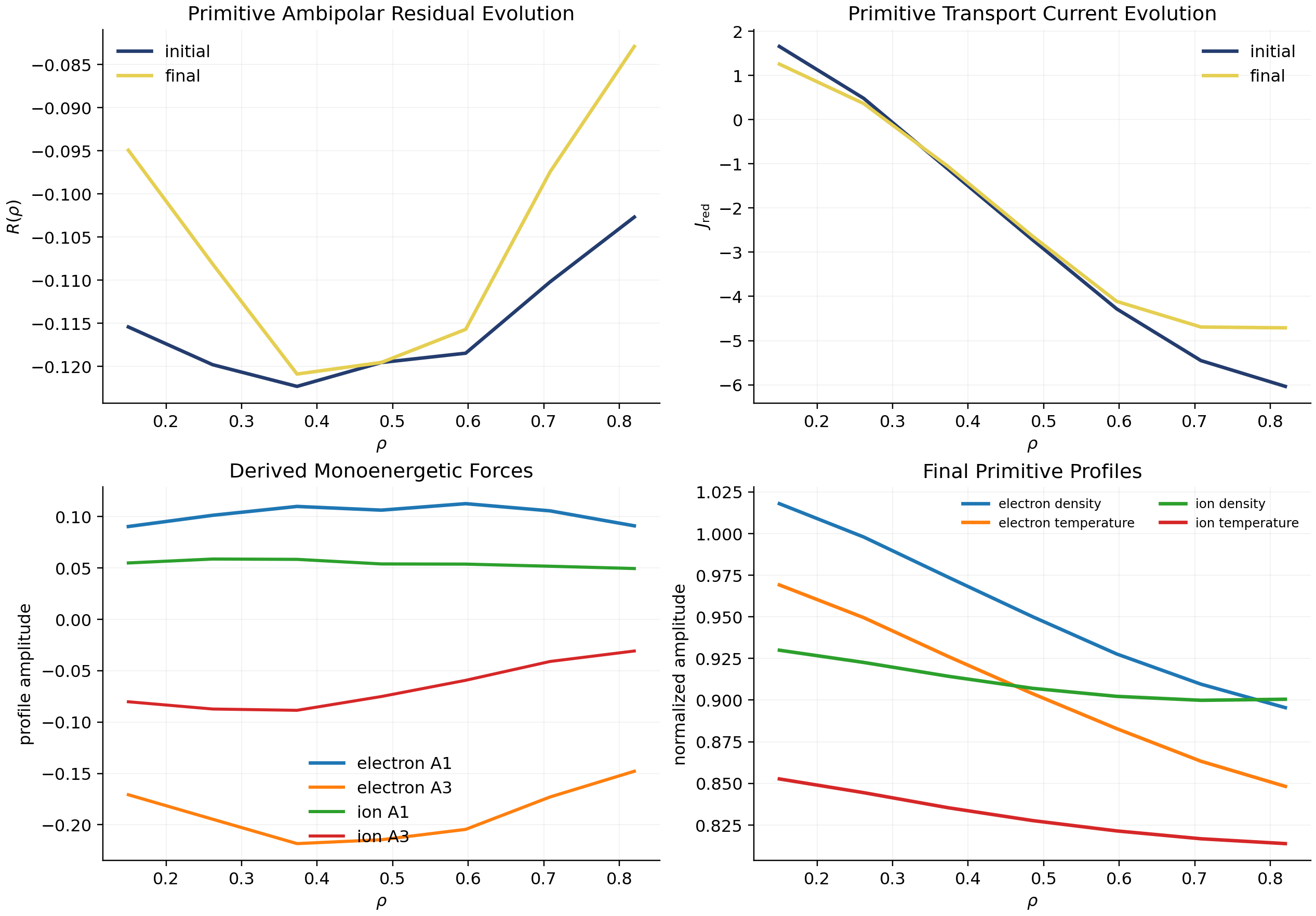
primitive_profile_transport.{png,pdf}
primitive density/temperature transport iteration mapped back to ambipolar-field and bootstrap-current evolution
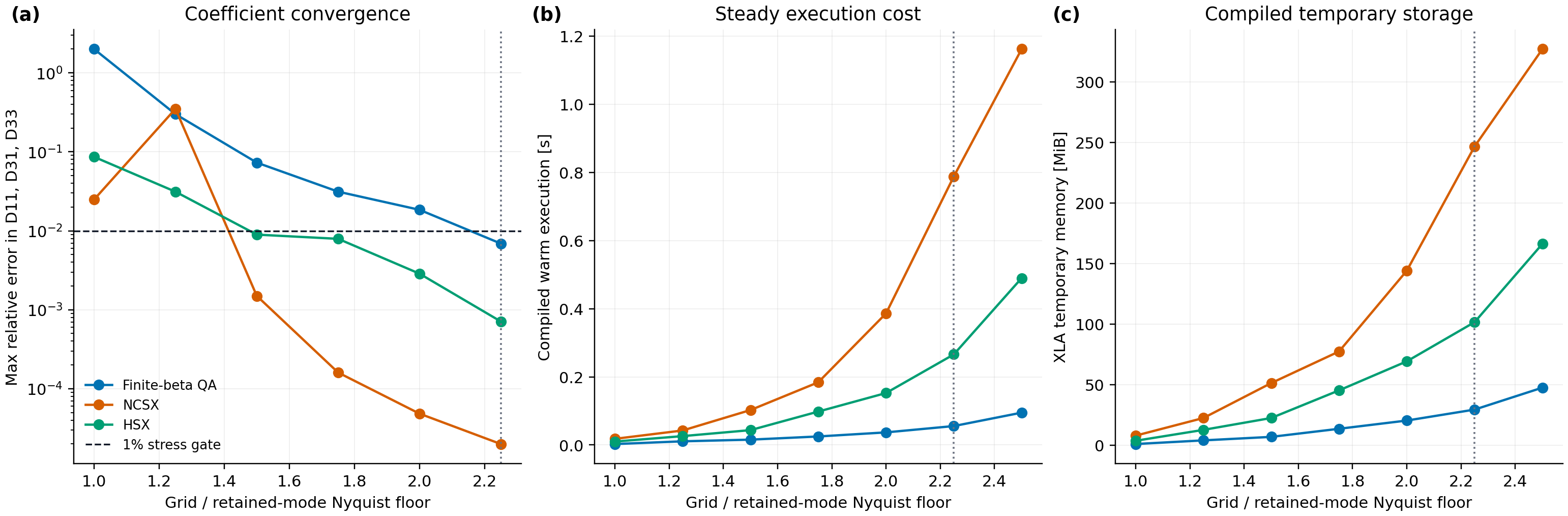
angular_oversampling_audit.{png,pdf,json}
finite-beta QA, NCSX, and HSX coefficient error, compiled warm runtime, and XLA temporary-memory evidence for the warning-level angular grid policy
Together these figures cover:
formulation and numerical behavior
validation and convergence
fixed-field Redl validation and reduced-closure total-current stress reporting
differentiable inverse and profile problems
differentiable uncertainty propagation on the same profile map
multi-parameter geometry-control derivative auditing
file-backed Boozer and VMEC geometry-control derivative auditing
boundary-to-output forward-mode auditing on projected
vmexgeometryimplicit-equilibrium derivative diagnostics that isolate where parity is lost: equilibrium volume matches, but Boozer geometry and NTX transport are closed as non-shipping diagnostics
equilibrium-relaxed boundary-to-current forward-mode auditing on committed QA/QH family cases
artifact-backed geometry-breadth status across the committed derivative families, with unresolved implicit objectives kept out of promoted claims
same-grid finite-beta Redl and
NTX+NEOPAXbootstrap-current stress diagnostics with the physical Boozer flux scale, normalized-radiusB00evaluation, production radial/collisionality ladder, adaptivenu/vsupport, Sonine-order convergence sidecar, and accepted RHSMode=1 pitch stress gap recorded as a closed reduced-closure stress benchmarkfinite-beta source-response and closure-target diagnostics that map the dominant effective-temperature channel over the full profile, rank physical geometry/trapped-particle/collisionality drivers, and keep fitted diagnostic models out of the runtime before any reduced closure change is promoted
production same-grid finite-beta SFINCS-JAX coefficient ladders that close radius/collisionality resolution as the leading explanation for that gap
a deterministic robust-design stress benchmark for differentiable current optimization
derivative cost for prepared optimization workflows
a science-facing bootstrap-current optimization workflow
a pure NTX radial-profile figure
a profile-grade ambipolar and reduced bootstrap-current response workflow
a control-parameter family view of the same profile-grade closure
a literature-anchored primitive-to-force reconstruction audit on the precise-QS profile family
a direct optimization view of the profile-grade closure
a low-dimensional multi-parameter version of that optimization
a self-consistent transport-relaxation view of the same closure
a primitive-profile transport view with positive density and temperature updates
a W7-X imported-workflow convergence figure
practical performance guidance
prepared-geometry and compiled-solver reuse guidance for optimization workloads
Manuscript Tables And Reproducibility
python scripts/build_manuscript_artifacts.py
This writes:
docs/_static/manuscript_artifacts.json
docs/_static/manuscript_tables.md
docs/_static/manuscript_claims.md
These artifacts collect the current NTX commit, software environment, the validated W7-X convergence numbers, derivative benchmark summaries, production-grid CPU/GPU performance and strong-scaling tables, geometry-control derivative stress metrics, finite-beta bootstrap-current stress and closure-localization metrics, bootstrap-current optimization summaries, and the exact commands needed to regenerate the figures and validation subset used in the manuscript.
One-Command Figure Bundle
python examples/make_publication_figures.py
This writes the full figure set into docs/_static/ and also creates:
docs/_static/publication_figure_manifest.json
Generate the frozen main-text set:
python examples/make_publication_figures.py --figures main_text
Generate the supplement set:
python examples/make_publication_figures.py --figures supplement
Science Figure
python examples/bootstrap_current_optimization.py
The science/application figure is written to:
docs/_static/bootstrap_current_optimization.png
docs/_static/bootstrap_current_optimization.pdf
docs/_static/bootstrap_current_optimization.json
It uses:
a VMEC-derived radial surface family
a dominant non-axisymmetric harmonic as the control parameter
a weighted bootstrap-current response based on the current-response coefficients
JAX autodiff to optimize that control directly
The committed JSON artifact is also a monitored benchmark-matrix and physics-gate entry: the optimized weighted-current response must remain at least as large as the baseline before the manuscript cites the gain. Broader stellarator-design claims still require reusable geometry-family controls and their derivative audits.
This is the recommended figure for a paper focused on differentiable bootstrap current analysis and optimization with NTX.
Prepared-Derivative Efficiency Figure
python examples/derivative_path_benchmark.py
This writes:
docs/_static/derivative_path_benchmark.png
docs/_static/derivative_path_benchmark.pdf
docs/_static/derivative_path_benchmark.json
Use this figure when the paper needs an explicit statement of how NTX moves from plain reverse-mode to a prepared differentiable workflow that is better suited to repeated optimization scans.
NTX Reduced Bootstrap-Current Response Figure
python examples/bootstrap_current_from_vmec_or_boozmn.py
This writes:
docs/_static/bootstrap_current_from_vmec_or_boozmn.png
docs/_static/bootstrap_current_from_vmec_or_boozmn.pdf
docs/_static/bootstrap_current_from_vmec_or_boozmn.json
It is the recommended figure when the paper needs a compact NTX-only radial profile panel without bringing in the external database workflow. The panel stays close to directly interpretable quantities: geometry, profile inputs, parallel-flow drive, and the resulting interior reduced bootstrap-current response built from analytic profile gradients.
Ambipolar Profile Figure
python examples/ambipolar_profile.py
This writes:
docs/_static/ambipolar_profile.png
docs/_static/ambipolar_profile.pdf
Use this figure when the paper needs a profile-grade closure panel built
entirely from NTX scan data, including the ambipolar residual landscape over
the scanned E_r axis and the resulting reduced bootstrap-current response.
Ambipolar Profile Family Figure
python examples/ambipolar_profile_family.py
This writes:
docs/_static/ambipolar_profile_family.png
docs/_static/ambipolar_profile_family.pdf
Use this figure when the paper needs an optimization-facing profile figure that shows how a scalar control changes the residual landscape and the reduced bootstrap-current response profiles, while also exposing a one-dimensional objective landscape.
Profile-Control Optimization Figure
python examples/profile_control_optimization.py
This writes:
docs/_static/profile_control_optimization.png
docs/_static/profile_control_optimization.pdf
Use this figure when the paper needs a direct optimization panel on top of the profile closure itself, rather than the separate geometry-control science figure.
Profile-Basis Optimization Figure
python examples/profile_basis_optimization.py
This writes:
docs/_static/profile_basis_optimization.png
docs/_static/profile_basis_optimization.pdf
docs/_static/profile_basis_optimization.json
Use this figure when the paper needs a profile-control optimization panel beyond one scalar amplitude while still keeping the optimization space compact and interpretable.
Profile Transport Loop Figure
python examples/profile_transport_loop.py
This writes:
docs/_static/profile_transport_loop.png
docs/_static/profile_transport_loop.pdf
Use this figure when the paper needs a self-consistent profile-transport panel instead of a pure control-optimization panel. It shows how the ambipolar residual, reduced bootstrap-current response, and thermodynamic-force profiles evolve under an accepted-step transport-relaxation iteration.
Primitive Profile Transport Figure
python examples/primitive_profile_transport.py
This writes:
docs/_static/primitive_profile_transport.png
docs/_static/primitive_profile_transport.pdf
Use this figure when the paper needs to move beyond direct A1/A3 channel
updates and show a primitive profile workflow in which density and temperature
remain positive, respond to explicit source-target closure terms, and feed back
into the ambipolar closure through reconstructed thermodynamic forces. The
panel is now framed around initial-versus-final closure profiles and the
derived monoenergetic forces rather than a noisy iteration trace.
W7-X Bootstrap-Current Convergence Figure
python examples/bootstrap_current_reference_audit_w7x.py
This writes:
docs/_static/bootstrap_current_reference_audit_w7x.png
docs/_static/bootstrap_current_reference_audit_w7x.pdf
docs/_static/bootstrap_current_reference_audit_w7x.json
Use this figure when the paper needs an explicit W7-X imported-workflow bootstrap-current convergence panel alongside the NTX-only methods figures.
Angular Oversampling Figure
python examples/angular_oversampling_audit.py --preset production
This figure supports the numerical-methods discussion by separating
coefficient convergence from compiled steady execution and temporary memory.
The 2.25-times-Nyquist line is a measured starting-grid recommendation;
successive-grid convergence remains the publication acceptance gate.